
Communication & Mode of Communication


Communication

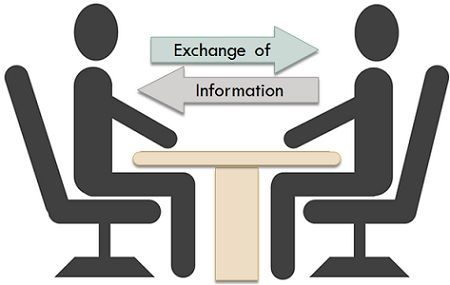
Definition: Communication is the process of transmitting information from one person to another. It is the act of sharing of ideas, facts, opinions, thoughts, messages or emotions to other people, in and out the organisation, with the use of the channel to create mutual understanding and confidence.

It is not tied to words, i.e. whether an individual speaks or not, the message is automatically conveyed to the other party. Besides words, communication can take place through symbols, letters, actions, expressions, etc.
communication

Elements of Communication

Communication is a two way process, wherein interchange of message connects the sender and receiver, towards an agreed direction, consisting seven elements:

  1. Sender: Otherwise known as a source, it is the person who has something to pass on, to another individual.
  2. Encoding: The sender of the message, selects appropriate words or non-verbal techniques to convert the idea into the message, which is called as encoding.
  3. Message: Message implies something that the sender wants to communicate, to the receiver. Without a message, no communication is possible.
  4. Medium: Medium alludes to the channel or mode, through which message is communicated to the receiver, i.e. it can be sent by way of electronic word processing system, graphic, symbol, etc.
  5. Receiver: The one to whom the message is directed, is called receiver. He/she notices and conveys some meaning to the message.
  6. Decoding: The act of interpreting message by the receiver, is termed as decoding. The receiver’s outlook, experience, and attitude play a vital role in decoding message.
  7. Feedback: The process of communication can never be completed, if the response of the receiver is missing. It enables the communicator of a message to know whether the message has been received and interpreted in the same manner as directed.

All the seven elements of communication has a great role to play in the entire process, as there can be some deformation between the intended message and the received one.

Forms of communication

  • Formal Communication: Alternatively known as official communication, it passes through predefined channels which all the members of the organisation are bound to follow. In every organisation, a corporate ladder is established, through which communication flows, which can be:
    • Downward: Superior to subordinate
    • Upward: Subordinate to superior
    • Horizontal: Between employees of the same level, but different areas of responsibility (department).
    • Diagonal: Between employees of different levels and department.
  • Informal Communication: The form of communication which grows spontaneously out of personal or social needs, among members of the organization, called as grapevine or informal communication. It is a secondary network of information in an organisation, which can be:
    • Single strand chain
    • Gossip chain
    • Probability chain
    • Cluster chain

Informal communication is the fastest form of communication, that rapidly transmits information to various members of the organisation. Further, the response of the members can also be obtained quickly.

Modes of Communication

modes of commun9ication

  • Verbal Communication: Communication, in which words (spoken or written) are used to transmit information is called verbal communication. It can be done in two ways:
    • Oral communication: E.g. Face to face conversation, telephonic conversation, lectures, speeches, conferences, etc.
    • Written communication: E.g. Letters, emails, newsletters, SMS, etc.
  • Non-verbal Communication: The communication between parties in which words are not used as a means for interchanging message, i.e. except words, other means are used like sounds, symbols, actions and expressions. Communication takes place non-verbally through:
    • Body language, E.g. Gestures, postures, body movements, etc.
    • Paralanguage, E.g. Pitch variation, tone, speaking speed, word stress, etc.
    • Sign language E.g. Hand movement, facial expressions, etc.
    • Time language E.g. time used to communicate our message.
    • Space language, E.g. Space maintained between the parties to communication, during the conversation.

Communication is the spine of the organization that without it no organisation can survive and operate effectively, towards attaining its goals. It is the primary means, by which organisational members work together. Further, it ties all the members of an organisation in a single thread and let them respond to and influence each other.

  • Digg
  • Del.icio.us
  • StumbleUpon
  • Reddit
  • Twitter
  • RSS

Purposes of-reading


 Purposes of-reading


  1. 1. Purposes of Reading Ahmad Sofwan sofwan1589@yahoo.com
  2. 2. Purposes of Reading• To search for simple information• To skim quickly• To learn from texts• To integrate information• To write (or search for information needed for writing)• To critique texts• For general comprehension
  3. 3. To search for simple information & to skim• Typically scan the text for a specific information or a specific word (e.g. a telephone directory to find key information)• To skim sampling segments of the text for general understanding• A combination of strategies to find the location of the information and use basic reading comprehension skills to obtain a general idea about the text
  4. 4. To learn from texts• Typically occurs in academic/professional contexts to learn a considerable amount of information from a text.• To remember main ideas & details of the main and supporting ideas in the text• Recognize and form rhetorical frames• Link the text to the reader’s knowledge base• Carried out at a slower reading rate• Makes stronger inferencing demands to connect the text information with background knowledge
  5. 5. To integrate information, write & critique texts• Requires critical evaluation of the information to decide what information to integrate and how to integrate it for the reader’s goal• Requires abilities to compose, select & critique information from a text
  6. 6. For general comprehension• Requires very rapid and automatic processing of words, strong skills in forming a general meaning representation of main ideas, efficient coordination of many processes
  7. 7. Reading Strategies• Specifying a purpose of reading• Planning what to do/what steps to take• Previewing the text• Predicting the contents of the text or section of text• Checking predictions• Posing questions about the text• Finding asnwers to posed questions• Connecting one part of the text to another• Paying attention to text structure
  8. 8. Reading Strategies• Rereading• Guessing the meaning of a new word from context• Using discourse markers to see relationships• Checking comprehension• Critiquing the author• Critiquing the text• Judging how well objectives were met• Reflecting on what has been learned from the text
  9. 9. Processes in fluent reading comprehension• a rapid process (200-300 words per minute)• an efficient process (coordinated & carried out automatically)• an interactive process (recognizing words & analyzing sentence structure to find clause-level meaning, finding main ideas, monitoring comprehension, etc; linguistic information from the text and background knowledge)
  10. 10. THE EXAMPLES• John is willing to help• John is difficult to help• John is willing to help someone• John is difficult for someone to help
  11. 11. Processes in fluent reading comprehension• a strategic process (recognize processing difficulties, address imbalances between text information & reader knowledge, & make decisions for monitoring comprehension and shifting goals for reading)• a flexible process (adjust with the changing purposes and ongoing monitoring of comprehension)• an evaluating process (must decide if the information is coherent and matches the purposes of reading; reader’s motivation, attitudes, feelings, expectation
  12. 12. Processes in fluent reading comprehension• a purposeful process (different ways based on different purposes; motivation is triggered by individual tasks or purposes)• a comprehending process (to understand a text)• a learning process (to learn new information through reading)• a linguistic process (not a reasoning process, understanding linguistic elements is important for text comprehension)
  13. 13. Reading processes occurring each & every two seconds we read• Focus on and access 8 to 10 word meanings• Parse a clause for information and form a meaning unit• Figure out how to connect a new meaning unit into the growing text model• Check interpretation of the information according to their purposes, feelings, attitudes, and background expectations, as needed• Monitor their comprehension, make appropriate inferences, shift strategies and repair misunderstanding, as needed• Resolve ambiguities, address difficulties and critique text information, as needed
  14. 14. Models of readingMetaphorical models of reading• Bottom-up models• Top-down models• Interactive modelsSpecific models of reading• Psycholinguistic Guessing Game Model• Interactive Compensatory Model• Word recognition models• Simple View of reading Model
  15. 15. Bottom-up models• All readings follows a mechanical pattern in which the reader creates a piece-by-piece mental translation of the information in the text, with little inference from the reader’s own background knowledge.• The reader processes each word letter-by-letter, each sentence word-by-word, and each text sentence-by-sentence in a linear fashion.
  16. 16. Top-down models• Primarily directed by reader goals and expectations.• The reader has a sets of expectation about text information & samples enough information from the text to confirm or reject.• The reader directs eyes to the most likely places in the text to find useful information
  17. 17. Interactive models• Take useful ideas from a bottom-up perspective and combine them with key ideas from a top-down view.• Word recognition needs to be fast and efficient, but background knowledge is a major contributor to text understanding.• Highlight the number of processes, particularly automatic processes, being carried out primarily in a bottom-up manner with little interference from other processing levels or knowledge resources.
  18. 18. Psycholinguistic Guessing Game Model• A universally applicable interactive process of (a) hypothesising, (b) sampling, and (c) confirming information based on a background knowledge, expectations about the text, a sampling of surface features of the text and context information from the text.
  19. 19. Interactive Compensatory Model• Readers develop efficient reading processes.• Less automatic processes interact regularly.• Automatic processes operate relatively independently, and• Reading difficulties lead to increased interaction and compensation, even among processes that would otherswise automatic.• Using context clues to understand a text better or to decide what a word means is a compensatory strategy when normally expected abilities break down, or have not been developed..

  • Digg
  • Del.icio.us
  • StumbleUpon
  • Reddit
  • Twitter
  • RSS

Extensive vs. Intensive Reading

Extensive vs. Intensive Reading

The two most important of reading styles are known as Intensive Reading and Extensive Reading. If you learn to master the what, how, and why of these two manners of reading, you will have two extremely powerful tools in your language learning arsenal, which will fuel your ability to acquire vocabulary indefinitely.

Reading, despite being one of the four major skills of language learning, is one of the skills that is most often neglected by language learners.

For the language learner who wishes to reach the upper levels of target language capability, this lack of reading poses a serious obstacle to the expansion of one's vocabulary, as a limited vocabulary offers less capacity to understand and, in turn, be understood.

So let me show you how you can change that.

Intensive Reading


To read intensively is to completely deconstruct a text, with the goal of absorbing as much meaning from it as possible. This is done by taking a text, and systematically looking up every word, phrase, or collocation that you do not understand.

This is an activity that requires great mental effort and focus. Because of this, the learner who engages in intensive reading must be careful to follow specific guidelines, or else risk boredom and burnout. Specifically, if you wish to read a text intensively, you must take care to read texts that are interesting and short, to read only for brief periods of time, and to do so when you have the most mental energy.

Let's explore these concepts in further detail:

  •     Texts for intensive reading must be interesting, because if you do not enjoy what you read, you will quickly forget the content, and have more mental resistance to the intensive reading process.
  •     Texts for intensive reading must be short, because the end goal is to understand the text down to the most minute detail. The longer a text is, the more laborious it is to complete such a deep analysis, so it is better to stick to shorter texts in order to avoid mental exhaustion.

Ideal learning materials for intensive reading include:

  •      News articles
  •       Wikipedia articles
  •     Short stories
  •     Blog posts
  •     You must intensively read for brief periods of time specifically to avoid the mental exhaustion that is described above. It takes much focus and effort to go from zero (or partial) understanding of a text to complete understanding, so it is best to limit intensive reading sessions to 30-35 minutes maximum.
  •     You must intensively read only when you have the most mental energy, in order to further boost your capacity for learning, and to reduce the risk of mental exhaustion that comes with deep analysis of even the shortest texts. Of course, mental energy levels fluctuate throughout the day—and even differ greatly from person to person—so exactly you should intensively read is something you need to determine for yourself.
  • Extensive Reading

To read extensively is to simply read as much as possible, without concerning oneself with the minutia of meaning and the occasional unknown word. This is done by reading for large swaths of time, and looking up words only when you deem it absolutely necessary to your understanding of the text.

If the text you wish to extensively read is at the appropriate level, you'll find that most unknown words can be deciphered by looking at their surrounding context, making overt use of translations or dictionaries unnecessary.

While intensive reading requires a high level of focus and deliberate effort, extensive reading is meant to be a fun and pleasurable experience, requiring a low expenditure of mental effort. The more extensive reading you do, the more language you are exposed to, allowing you to increase your passive knowledge of vocabulary quite quickly.

Specifically, if you wish to read a text extensively, you must read texts that are interesting, level-appropriate, of moderate length, to read when you can dedicate longer blocks of time, and to do so when you are relaxed.

Let's explore each of these aspects of extensive reading in deeper detail:

  •      As in intensive reading, texts for extensive reading must be interesting. Since extensive reading is done for longer periods of time, you must take care to select texts that hold your attention, and keep you coming back for more, hour after hour.
  •      Texts for extensive reading must be level-appropriate. Since you will not be attempting to understand every single word and phrase (as in intensive reading), you must be able to understand a high-percentage of a text before you even begin. The goal is to absorb unknown words through context; therefore, if you don't understand the bulk of the context, the text is not yet appropriate for you to read extensively.
  •      Texts for extensive reading must be of moderate length. Specifically, a text should be, on average at least 15-30 pages long. Texts of this length are long enough to fully develop an idea or narrative, and require you to keep mental "track" of ideas, concepts or characters as they develop over time.

Ideal learning materials for extensive reading include:

  •       Graded Readers
  •      Online Platforms such as LingQ (affiliate)       
  •      Bilingual & Interlinear Books (affiliate)
  •      Monolingual (Native) Books
  •      Magazines
  •      Comic Books
  •        Extensive reading must be done for longer blocks of time when compared to intensive reading. This is because you will be reading longer texts, which naturally require more time to read, and because sitting down to read for longer periods allow you to get into the "flow" of reading, and therefore mentally process the material more deeply. When aiming to extensively read a text, it is best to do so for sessions of an hour or more.
  •      When extensively reading, it is best to stay relaxed. Reading in a relaxed, low-stress environment will help you associate reading with pleasure, and therefore increase your willingness to read more often, and for longer periods. Clearly, you don't want to be so relaxed that you fall asleep, but instead just relaxed enough that you feel comfortable, and willing to absorb whatever you're reading.

Extensive vs. Intensive Reading


By now, you understand the how to read, what to read, and why to read of both Intensive and Extensive Reading. Though you may feel more compelled to one style of reading over the other, don't fall into the trap of thinking that one method is intrinsically better.

Instead, it is important to realize that both styles of reading have their uses, and you should use both styles in tandem (across different texts) in order to bolster your vocabulary acquisition quickly and effectively.

Remember that extensive reading and intensive reading are, at their very core, simply tools. Whenever and wherever you read in your target language, if you know which of these tools is the right tool for the job, you'll be able to maximize your learning, and take your language skill to new heights.

  • Digg
  • Del.icio.us
  • StumbleUpon
  • Reddit
  • Twitter
  • RSS

SKIMMING & SCANNING

 SKIMMING & SCANNING

Skimming and scanning are reading techniques that use rapid eye movement and keywords to move quickly through text for slightly different purposes. Skimming is reading rapidly in order to get a general overview of the material. Scanning is reading rapidly in order to find specific facts. While skimming tells you what general information is within a section, scanning helps you locate a particular fact. Skimming is like snorkeling, and scanning is more like pearl diving.

Use skimming in previewing (reading before you read), reviewing (reading after you read), determining the main idea from a long selection you don't wish to read, or when trying to find source material for a research paper.

Use scanning in research to find particular facts, to study fact-heavy topics, and to answer questions requiring factual support.

Skimming to save time
Skimming can save you hours of laborious reading. However, it is not always the most appropriate way to read. It is very useful as a preview to a more detailed reading or when reviewing a selection heavy in content. But when you skim, you may miss important points or overlook the finer shadings of meaning, for which rapid reading or perhaps even study reading may be necessary.

Use skimming to overview your textbook chapters or to review for a test. Use skimming to decide if you need to read something at all, for example during the preliminary research for a paper. Skimming can tell you enough about the general idea and tone of the material, as well as its gross similarity or difference from other sources, to know if you need to read it at all.

To skim, prepare yourself to move rapidly through the pages. You will not read every word; you will pay special attention to typographical cues-headings, boldface and italic type, indenting, bulleted and numbered lists. You will be alert for key words and phrases, the names of people and places, dates, nouns, and unfamiliar words. In general follow these steps:


  1. Read the table of contents or chapter overview to learn the main divisions of ideas.
  2. Glance through the main headings in each chapter just to see a word or two. Read the headings of charts and tables.
  3. Read the entire introductory paragraph and then the first and last sentence only of each following paragraph. For each paragraph, read only the first few words of each sentence or to locate the main idea.
  4. Stop and quickly read the sentences containing keywords indicated in boldface or italics.
  5. When you think you have found something significant, stop to read the entire sentence to make sure. Then go on the same way. Resist the temptation to stop to read details you don't need.
  6. Read chapter summaries when provided.


If you cannot complete all the steps above, compromise: read only the chapter overviews and summaries, for example, or the summaries and all the boldfaced keywords. When you skim, you take a calculated risk that you may miss something. For instance, the main ideas of paragraphs are not always found in the first or last sentences (although in many textbooks they are). Ideas you miss you may pick up in a chapter overview or summary.

Good skimmers do not skim everything at the same rate or give equal attention to everything. While skimming is always faster than your normal reading speed, you should slow down in the following situations:

  • When you skim introductory and concluding paragraphs
  • When you skim topic sentences
  • When you find an unfamiliar word
  • When the material is very complicated


Scanning for research and study
Scanning, too, uses keywords and organizational cues. But while the goal of skimming is a bird's-eye view of the material, the goal of scanning is to locate and swoop down on particular facts.

Facts may be buried within long text passages that have relatively little else to do with your topic or claim. Skim this material first to decide if it is likely to contain the facts you need. Don't forget to scan tables of contents, summaries, indexes, headings, and typographical cues. To make sense of lists and tables, skim them first to understand how they are organized: alphabetical, chronological, or most-to-least, for example. If after skimming you decide the material will be useful, go ahead and scan:

  1. Know what you're looking for. Decide on a few key words or phrases–search terms, if you will. You will be a flesh-and-blood search engine.
  2. Look for only one keyword at a time. If you use multiple keywords, do multiple scans.
  3. Let your eyes float rapidly down the page until you find the word or phrase you want.
  4. When your eye catches one of your keywords, read the surrounding material carefully.


Scanning to answer questions
If you are scanning for facts to answer a specific question, one step is already done for you: the question itself supplies the keywords. Follow these steps:

  1. Read each question completely before starting to scan. Choose your keywords from the question itself.
  2. Look for answers to only one question at a time. Scan separately for each question.
  3. When you locate a keyword, read the surrounding text carefully to see if it is relevant.
  4. Re-read the question to determine if the answer you found answers this question.

Scanning is a technique that requires concentration and can be surprisingly tiring. You may have to practice at not allowing your attention to wander. Choose a time and place that you know works for you and dive in.

  • Digg
  • Del.icio.us
  • StumbleUpon
  • Reddit
  • Twitter
  • RSS